
Research Excellence From the Very Beginning
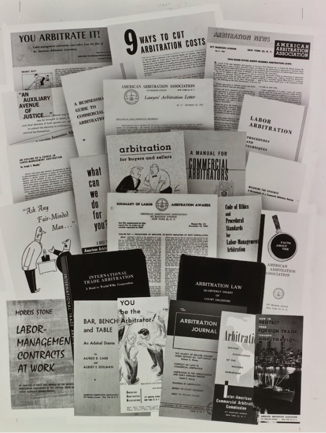
The American Arbitration Association®, a collaborative dream of peace, neutrality, and fairness born from the ashes of World War I, turns 100 this month.[1] Almost as remarkably, its global role as a research and education powerhouse for alternative dispute resolution (ADR) is celebrating 99 years.[2] The two have grown hand in hand, propelling the promise of fair, amicable resolution into new frontiers.
In 1927, however, the AAA® stood at a crossroads. “The field was so vast and the opportunities so great, and the funds for such work were so limited, that it was difficult to chart a constructive course,” cofounder Frances Kellor wrote decades later.[3] The vision was there, but the resources were not.
A transformative grant from John D. Rockefeller Jr. changed that.[4] Suddenly, the AAA had the means to match its ambition. With Rockefeller’s support and the guidance of a research council that included diverse business minds — including National American Bank, Packard Motor Car, Monroe Calculating Machine Co., and more — the AAA set out to conduct the first comprehensive study of its kind.[5]
Cutting the Edge
Long before “design thinking” and user-focused innovation became buzzwords in Silicon Valley, the AAA embraced a similar approach to improve and expand arbitration. Its pioneering inquiry into the history and status of commercial arbitration in the United States revealed something unexpected: More than 300 organizations were already using arbitration in one form or another in their communities.[6]
The resulting “Year Book on Commercial Arbitration in the United States,” published in 1927, was just as its name suggested. For the first time, organizations using arbitration could see how others approached it, learn their policies and standards, and adopt best practices to strengthen their programs.[7]
The study brought trade, commercial, and financial organizations into close cooperation with the AAA, and the research council distributed the “Year Book” widely, sparking a virtuous cycle of learning and amplifying. Next, the AAA conducted a foundational study on existing laws and court practices that resulted in the publication of its first “Code of Arbitration Practice and Procedure” in 1931. Like the “Year Book” before it, the “Code” became an essential resource, bringing arbitration practices up to date and providing businesses and bar associations with a practical guide to drafting submissions and clauses, selecting arbitrators, and more — serving as the first true manual for commercial arbitration.[8]
A Home for Thought and Leadership
As its library of knowledge grew, the AAA recognized the need for a platform to share its insights more broadly and make them accessible to the public. In 1937, it launched the Arbitration Journal, which became the quarterly Dispute Resolution Journal in 1993 and remains in publication today.[9]
President Lucius R. Eastman’s words introducing the Journal in 1937 still resonate as the tools of ADR are reimagined and applied in service of a more peaceful, fair world: “There is afforded the opportunity to follow not only the adventure of ideas but to present some of the adventures. In this way human knowledge will be extended and the pattern of science will begin to take form.”[10]
Indeed, over the decades, that scientific pattern has emerged — and the AAA continues to push its boundaries. As it enters its second century, the AAA stands as a living laboratory, ready to test, prove, and scale resolution solutions around the world.
[1] American Arbitration: Its History, Functions and Achievements, page 9
[2] American Arbitration: Its History, Functions and Achievements, page 44
[3] American Arbitration: Its History, Functions and Achievements, page 44
[4] American Arbitration: Its History, Functions and Achievements, page 44
[5] American Arbitration: Its History, Functions and Achievements, pages 44 and 204
[6] American Arbitration: Its History, Functions and Achievements, pages 44–45
[7] American Arbitration: Its History, Functions and Achievements, pages 44–45
[8] American Arbitration: Its History, Functions and Achievements, pages 44–46
[10] American Arbitration: Its History, Functions and Achievements, page 49