
A Cordial Conference, an Earth-Shaking Agreement
Trading for Post-War Peace
Trade creates growth. Growth creates peace. Barriers to world trade are barriers to peace. This is most visible in the aftermath of war, when nations turn to trade and prioritize stability above all.
After World War I, a surge in global trade highlighted a major problem: Arbitration awards weren’t easily enforceable across borders. Knowing global trade was key to maintaining peace, the League of Nations stepped in to address it with provisions in the Geneva Protocol of 1923 and the Geneva Convention of 1927.[2]
With this new need for innovative methods of arbitration came a new caseload for the American Arbitration Association®. By 1932, the association was handling cases from Belgium, Germany, Japan, and Latin America.[3] It quickly became clear that different countries needed tailored approaches. From the 1930s to the 1950s, the AAA® worked around the world — in Manchester, the Philippines, and the Netherlands, to name a few places — spreading the gospel of arbitration.[4]
A New Convention
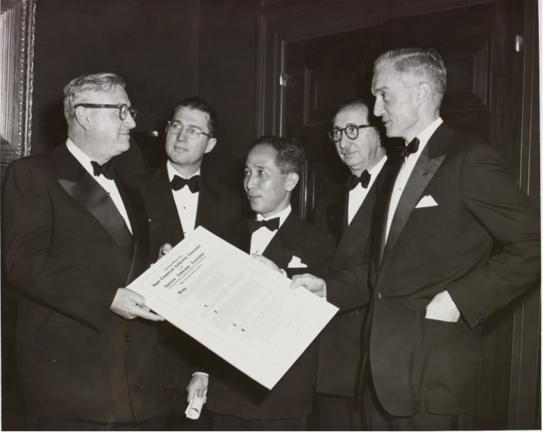
By the 1950s, the postwar economic explosion demanded an even stronger solution.[5] On May 20, 1958, more than 50 delegations representing 45 countries[6] gathered in New York to solve the problem of enforcing cross-border arbitration awards once and for all.[7] The AAA was among the organizations selected to share its expertise and help guide those discussions.[8]
With hundreds of people present speaking dozens of different languages, it could have been chaos. Instead, it was surprisingly cordial. Despite their many differences on paper, everyone in that room had one thing in common — what papal representative Bishop James H. Griffiths described as “a genuine concern to … aid businessmen and arbitrators around the world to dispose of their disputes fairly, quickly, economically and as privately as possible.”[9]
The result was a five-page document: the New York Convention on the Recognition and Enforcement of Foreign Arbitral Awards. Brief in length, massive in impact, it has been described as the “single most important pillar on which the edifice of international arbitration rests.”[10]
Continuing the Pursuit of Peace With the ICDR®
The 1958 New York Convention was key to arbitration becoming the go-to solution for international commercial disputes.[11] In 1996, the AAA took things further, launching its international arm, the International Centre for Dispute Resolution® (ICDR), and solidifying its global leadership.[12] As the world’s leading provider of global cross-border conflict-resolution solutions,[13] the ICDR is ready to tackle the next great global challenge — a testimony to the fact that cooperation will always conquer chaos.
[1] AAA Archives AAA_Digitized Files_Metadata_tif
[3] Pioneers in Dispute Resolution A History of the American Arbitration Association On Its 65th Anniversary (1926-1991), page 9
[4] American Arbitration: Its History, Functions and Achievements, Frances Kellor, pages 148-153, 233; 1950s_Assorted Arbitrator News.pdf
[6] Foreign Arbitral Treaty is Passed, The Tablet, Sat, Jun 21, 1958, Page 20; 1950s_Assorted Arbitrator News.pdf
[7] 1950s_Assorted Arbitrator News.pdfPDF page 9
[8] 1950s_Assorted Arbitrator News.pdfPDF page 36
[10] A New York Convention Primer (ABA); https://www.newyorkconvention.org/media/uploads/pdf/1/2/12_english-text-of-the-new-york-convention.pdf; https://www.google.com/books/edition/Law_and_Practice_of_International_Commer/9mBqDaSB-ZwC?hl=en&gbpv=1&dq=%22%E2%80%9Csingle+most+important+pillar+on+which+the+edifice+of+international+arbitration+rests.%E2%80%9D&pg=PA133&printsec=frontcover; The Present Status of the International Court of Arbitration of the ICC: An Appraisal, J. Gillis Wetter, 1990