
Building One of the AAA’s Largest Commercial Caseloads
America’s First Mediators
According to AAA Senior Vice President and Chief People Officer Eric Dill, arbitration in America traces its roots back to the railroads. “When you’re thinking about building a railroad,” he explained, “you’re not near cities and towns that have judges and those sorts of things. And when there was a dispute on the project, it could shut everything down.”[1] Foremen were therefore some of the nation’s earliest mediators — which is fitting, given that construction is one of the American Arbitration Association's most substantial individual commercial caseloads today.[2]
Building the Foundations
The AAA’s decades long partnership with the construction industry dates back to at least the early 1930s, when the American Institute of Architects (AIA) adopted an arbitration clause into its contract, setting a new standard.[3] Later, the AIA went even further, explicitly naming the AAA’s rules in its form contracts, and what was already a significant caseload grew exponentially.[4]
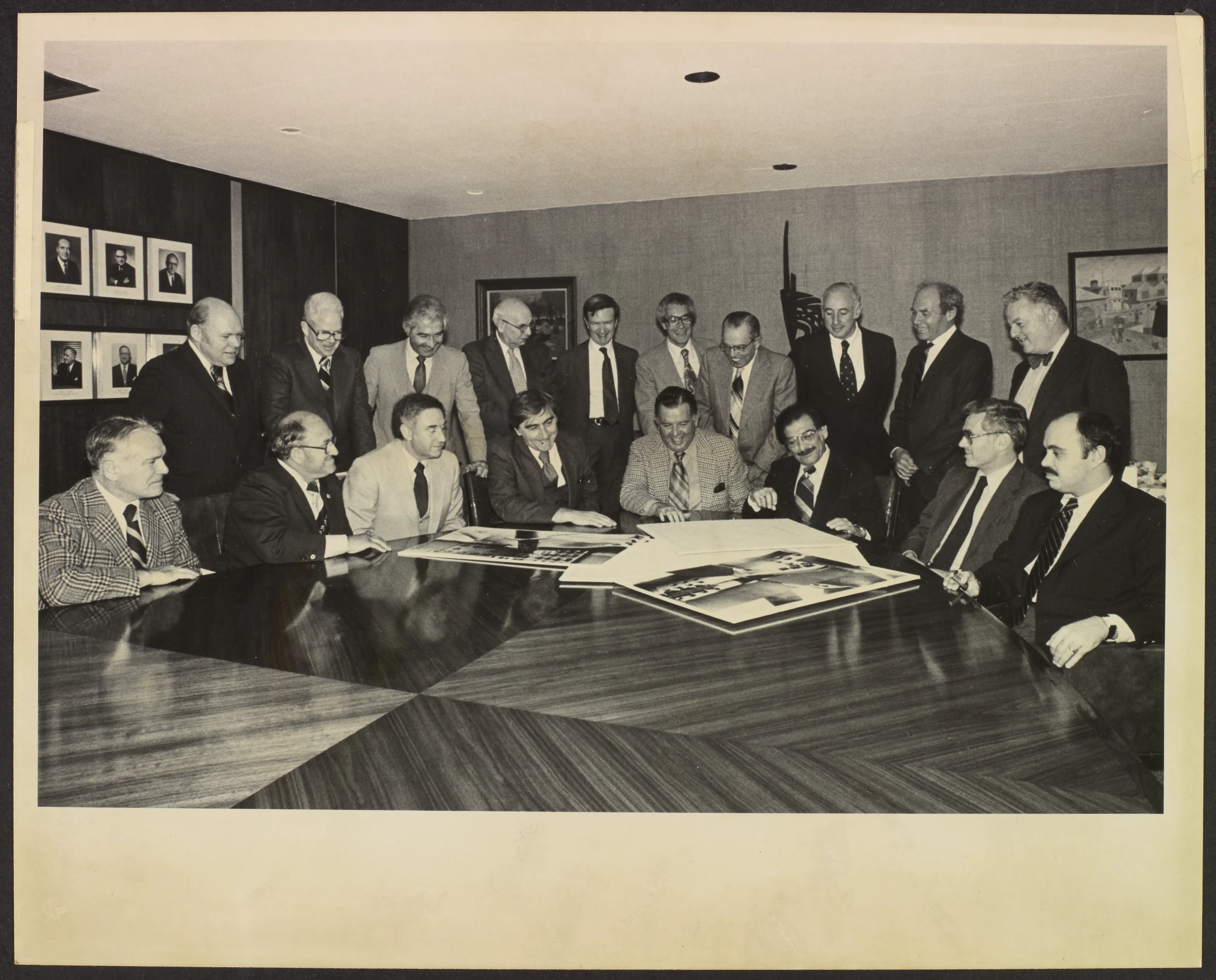
In response, Robert Coulson, who was president of the AAA at the time, helped create the National Construction Industry Arbitration Committee in 1966[5] to manage the AAA’s swiftly growing construction caseload. Later renamed the National Construction Dispute Resolution Committee (NCDRC),[6] it allowed the AAA to recruit and train qualified arbitrators from across construction disciplines.[7]
True wisdom is knowing what you don’t know. “We realize that we are not always the smartest people in the room,” said AAA Executive Vice President and Chief Operating & Revenue Officer Francesco (Frank) Rossi. “So somebody well before my time thought that it would be a great idea to have a committee established of construction industry executives — and not just contractors but architects, engineers, lawyers in the field, developers, basically anyone who might be involved in a construction project — and have them provide input and feedback on how our services could be better suited to their types of disputes.” The NCDRC meets twice a year to this day.[8]
A Perfect Fit
It’s no coincidence that construction and arbitration go hand in hand. On a job site, delays aren’t just inconvenient — they can also be budget-gutting, project-ending, and even life-threatening. That’s why disputes need to be resolved as quickly and fairly as possible when they arise.[9] It’s also why the construction industry is constantly seeking the next efficiency-fueling technological innovation.[10] The AAA delivers on both fronts.
The AAA’s new AI arbitrator, announced in September 2025, uses generative AI trained on real arbitrators to help settle disputes. Its first implementation? Documents-only construction cases.[11]
“The construction industry has always been at the forefront of technology,” said AAA Senior Vice President of Dispute Resolution Services Christine Newhall. “They are an industry that will try new things, because they do it every day.”[12]
Impact-driven innovation — it’s what builds buildings, and it’s what has built the AAA.
[1] Eric Dill Oral History, AAA/HF, 2025
[2] Francesco (Frank) Rossi Oral History, AAA/HF, 2025
[3] 1991_Pioneers in Dispute Resolution_65th anni book.pdf(page 9, PDF page 8)
[4] 1991_Pioneers in Dispute Resolution_65th anni book.pdf(page 17, PDF page 12)
[5] https://archive.org/details/civilengineersin0000unse/page/2/mode/2up?q=%22national+construction+industry+arbitration+committee%22; https://www.google.com/books/edition/Avoiding_or_Minimizing_Construction_Liti/IWC3BbGhIWUC?hl=en&gbpv=1&dq=%22national+construction+industry+arbitration+committee%22&pg=PA342&printsec=frontcover; https://www.google.com/books/edition/Hearings/qTixOVEH5XUC?hl=en&gbpv=1&dq=%22national+construction+industry+arbitration+committee%22&pg=RA1-PA111&printsec=frontcover
[6] 1991_Pioneers in Dispute Resolution_65th anni book.pdf(page 22, PDF page 15)
[7] 1991_Pioneers in Dispute Resolution_65th anni book.pdf(page 17, PDF page 12)
[8] Francesco (Frank) Rossi Oral History, AAA/HF, 2025
[9] 1991_Pioneers in Dispute Resolution_65th anni book.pdf(page 22, PDF page 15)
[10] Francesco (Frank) Rossi and Christine Newhall Oral Histories, AAA/HF, 2025
[12] Christine Newhall Oral History, AAA/HF, 2025