
Suffragette, Presidential Advisor, Fearless Leader of the AAA®
“The spirit to be striven for is not grim determination to win at any cost but the exhilaration and joy of playing.”
— Frances Kellor, Gertrude Dudley, “Athletic Games in the Education of Women" (1909)[1]
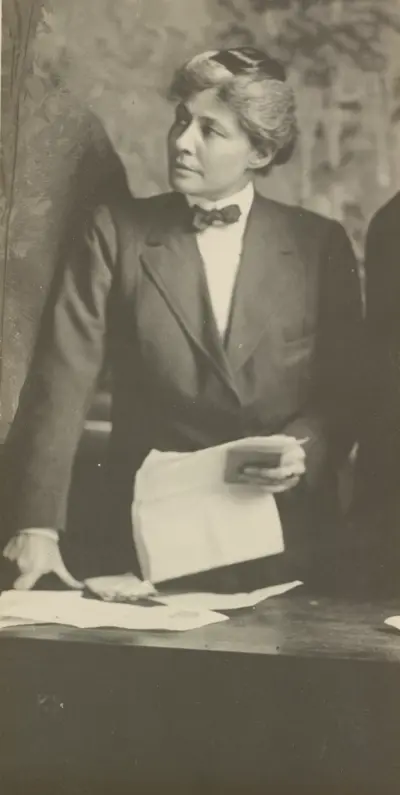
When the American Arbitration Association® debuted a century ago, its first vice president, Frances Kellor, was nowhere to be found in the photo op.[2] An architect of private dispute resolution and author of its defining manuals, she deserved to be front and center.[3] But Kellor likely shrugged and went right back to building the system rooted in fairness, neutrality, and justice that defines the AAA today. Besides, she wasn’t interested in picking fights. She was captivated by the joyful pursuit of resolution.
Kellor’s life was shaped by adversity — her dedication to inclusion was rooted in personal experience. Raised by a single mother working as a laundress, Kellor dropped out of high school to support her family. A job as a typesetter quickly evolved into investigative reporting. Kellor’s talents caught the eye of two wealthy sisters who sponsored her education at Cornell University Law School, where she was only the third woman to earn a degree.[4][5]
Kellor opened doors long closed to women — and stepped through them as a leader of men.[6] Yet it was a job she took as a gymnastics instructor while she was studying criminal sociology at the University of Chicago that sparked her belief in the leveling power of rules. [7]
In her first scholarly article and later in her book “Athletic Games in the Education of Women” (1909),[8] Kellor argued that sports build social cohesion and inspire sound judgement. “The organized game is the active expression of one’s natural self,” she wrote, “a miniature of the democracy which envelopes one in later years.”[9]
To affect the change she knew was possible, Kellor pivoted to politics, focusing her efforts on immigrant rights.[10] An advisor to Theodore Roosevelt’s 1912 presidential campaign, Kellor shaped the Progressive Party’s platform before women had the right to vote.[11] In 1921, she transitioned from studying immigration policy to international arbitration, recognizing it as a promising tool for building goodwill and world peace.[12] To Kellor, fairness was not an abstract ideal but a practical mandate that required concrete rules.
In 1926, she cofounded the AAA, infusing its mission with that belief. In her book “American Arbitration: Its History, Function and Achievements” (1948), Kellor espoused that tenet: “It is peculiarly American … there should be an institution that brings tranquility and happiness out of the chaos which disputes make in the lives of men and nations.”[13]
Kellor, who served on the AAA’s board of directors until her death in 1952, was more than an architect of the AAA and modern dispute resolution. She was an inspiration — a coach, umpire, and champion of a fairer society — and the first of many women leaders to carry that legacy forward.[14] “By giving everybody, not just institutions that had significant resources, the ability to have a voice in how they resolve their disputes and do it on their own terms and preserve relationships and come out of it with creative solutions, [Frances Kellor] believed that was a recipe for a better world,” said AAA CEO and President Bridget McCormack. “We still think that, and we just have more tools to be able to deliver on it.”[15]
For 100 years, the AAA has shaped the future of ADR — fast, fair, and fearless. We break barriers with innovation that expands access to justice for all. Always neutral, never passive, we are the world’s leading alternative dispute resolution service provider. And we’re just getting started.
[1] Athletic Games in the Education of Women, page 26
[2] Internal_AAA Greatest hits, slide 21; “Arbitral Agencies Merged,” Architecture and Building vol. 58, 1926, 22; AAA Archival Image: “AAA Founders,” Historical Box 1914 Frances Kellor Portraits of Directors to 1930, AAA Archives; American Arbitration: Its History, Functions and Achievements, page 17
[3] 1991_Pioneers in Dispute Resolution_65th anni book.pdf, pages 6–9
[4] Internal_AAA Greatest hits, slide 28
[5] Frances Kellor and the Americanization Movement, Allison D. Murdach
[6] Frances Kellor and the Americanization Movement, Allison D. Murdach
[7] https://legacyprojectchicago.org/person/frances-kellor; https://academic.oup.com/sw/article-abstract/53/1/93/1859329?redirectedFrom=fulltext&login=false
[8] Athletic Games in the Education of Women, 1909
[9] Athletic Games in the Education of Women, 1909, page 27
[10] https://www.michiganpublic.org/politics-government/2016-02-09/remembering-frances-kellor-defender-of-the-downtrodden
[11] Frances Kellor and the Americanization Movement, Allison D. Murdach
[12] https://www.michiganpublic.org/politics-government/2016-02-09/remembering-frances-kellor-defender-of-the-downtrodden
[13] American Arbitration: Its History, Functions and Achievements, page xi,17
[14] https://go.adr.org/2021-international-womens-day.html
[15] Bridget McCormack OH, 11:45