
Rolling Credits on Blind Buying
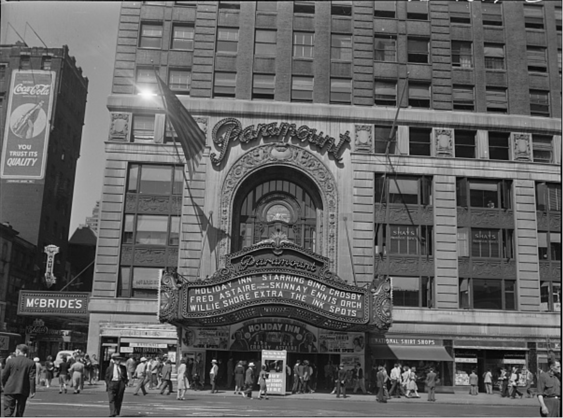
As one industry expert put it, “No other single event so influenced the development and present character of the [American Arbitration] Association®.” It was no exaggeration: On Nov. 20, 1940, with the passage of the Motion Picture Consent Decree, the AAA® became a truly national organization,[1] pioneering a system of arbitration that reshaped Hollywood itself.
Once Upon a Time in Hollywood…
Paradoxically, the Great Depression catalyzed the Golden Age of Hollywood. Escapism was in high demand. Milk was expensive, but even if you didn’t have a dime, you could trade in empty bottles for a ticket to Oz.[2]
Major film studios like Paramount dominated,[3] but their power soon drew the eyes of the Department of Justice. In 1938, the “Big Eight”[4] film studios faced a major antitrust suit and charges of monopolizing and price fixing.[5] They desperately needed a faster, more affordable solution.[6] The show had to go on.
The time had come for compromise.
Lights, Camera … Arbitration!
Meanwhile, the AAA was expanding arbitration across industries — construction, insurance, labor, and more — all from its single office in Rockefeller Center. But nationwide growth remained out of reach.
That was about to change.[7]
In 1940, the five largest studios of the “Big Eight” entered into a consent decree with the DOJ. The studios agreed to end “blind buying” — which forced theaters to purchase a studio’s entire season of films without ever seeing them — and in return, the government agreed not to make any attempts to close the studios’ theaters for a period of three years. During that window, the AAA was chosen to administer arbitration between distributors and exhibitors.[8]
That’s Not All, Folks
This wasn’t business as usual for anyone involved, including the AAA: It introduced a new form of arbitration. Under this model, the U.S. government was involved, and the beneficiaries — exhibitors — weren’t party to the decree itself. The AAA provided a structured arbitration system to quickly and fairly resolve any disagreements between studios and theaters. This government-backed, industry-wide approach protected third parties and tackled a national problem head-on.[9] It was bold, ambitious, and groundbreaking.
As Frances Kellor wrote, “It has been demonstrated that it is feasible for Government and business to co-operate … and that for the welfare of a country co-operation, rather than prosecution, may produce the greatest benefit.”[10]
Because the problem was national in scope, the decree meant the AAA needed to match its scale, spurring the opening of 31 regional offices.[11] The door to national expansion had swung open in cinematic fashion.
Fairness: Now Showing in a Theater Near You
The 1940 Motion Picture Consent Decree ushered in an era of compromise, securing fairness in the film industry and propelling the AAA into national prominence. It also proved two enduring truths: Arbitration can bridge government and business — and the AAA can be a leading actor in providing that bridge.
[1] Pioneers in Dispute Resolution A History of the American Arbitration Association On Its 65th Anniversary (1926-1991), pages 9-10
[4] https://www.google.com/books/edition/Hollywood_s_America/4tFMDwAAQBAJ?hl=en&gbpv=1&dq=%22hollywood%22+%22big+eight%22&pg=PT25&printsec=frontcover https://www.cobbles.com/simpp_archive/1film_antitrust.htm
[6] American Arbitration: Its History, Functions and Achievements, Frances Kellor, page 92
[7] Pioneers in Dispute Resolution A History of the American Arbitration Association On Its 65th Anniversary (1926-1991), pages 9-10
[9] American Arbitration: Its History, Functions and Achievements, Frances Kellor, page 93; https://ir.lawnet.fordham.edu/cgi/viewcontent.cgi?article=1223&context=flr
[10] American Arbitration: Its History, Functions and Achievements, Frances Kellor, page 99