A. Introduction
Experienced mediators recognize that when parties frequently arrive at mediation, they are convinced that their understanding of the dispute is correct and that a judge or jury will validate their position. When opposing parties hold sharply different views about what happened, who bears responsibility, and what constitutes a fair outcome, negotiations can stall even when continued litigation presents a significant risk to both sides.
Most barriers to settlement arise not from the legal merits of the dispute, but from the way the parties perceive those merits. Their views of facts, risks, and potential outcomes are shaped by cognitive and emotional biases such as optimism, distrust, anger, and competitiveness, which often reinforce positional bargaining and hinder compromise. As a result, parties may overestimate their chances of success in court or dismiss reasonable settlement offers, leading to prolonged disputes and increased costs. For instance, a plaintiff might view the same piece of evidence as highly favorable to their case, while the defendant sees it as insignificant or even supportive of their own position.1
When these perception-based barriers harden, negotiations often reach what participants describe as “impasse.” In mediation practice, however, impasse often dissolves when parties reassess the legal merits of their claims, reevaluate litigation risk, and begin to see the dispute through a different lens.
Negotiation scholarship offers a framework for understanding how these shifts occur. Roger Fisher and William Ury famously argued that effective negotiators should focus not on positions but on the interests underlying those positions.2 William Ury later emphasized that negotiators sometimes must step back from confrontation in order to reconsider their choices and identify new paths toward agreement.3
This article builds on those insights and argues that mediators overcome impasse primarily by reshaping how parties perceive the dispute. In particular, experienced mediators help parties reconsider three critical perceptions: risk, fairness, and possibility. When those perceptions begin to shift, settlement often follows.
B. Perception Barriers in Mediation
Perception barriers often lead negotiators to become increasingly confident in their own case while simultaneously discounting the legitimacy of the opposing side’s claims.
Negotiations frequently stall because parties become trapped in predictable patterns of thinking that distort how they evaluate the dispute. Rather than assessing evidence and litigation risk through purely objective analysis, negotiators interpret facts and settlement proposals through cognitive and emotional filters that shape their understanding of the conflict. These perception barriers often lead parties to become increasingly confident in their own case while simultaneously discounting the legitimacy of the opposing side’s claims.
Many of these barriers arise from well-documented cognitive biases studied extensively in negotiation and behavioral decision-making research. Several biases are particularly influential in litigation mediation.
1. Partisan Perception
One of the most significant perception barriers is partisan perception. Social psychologists have observed that individuals tend to interpret information in ways that reinforce their existing beliefs while discounting information that challenges them. This dynamic is closely related to selective perception (“we only see the facts that support our case”) and confirmation bias (“we only interpret new information to reinforce our existing beliefs”)—tendencies that lead individuals to notice and remember facts that support their position while ignoring or minimizing contradictory information. As a result, disputants often become increasingly confident in their own case while simultaneously discounting the legitimacy of the opposing side’s claims.4
These dynamics of perception are particularly powerful in litigation disputes because parties typically arrive at mediation after months—or even years—of adversarial preparation. Lawyers and clients have developed narratives about the dispute, internalized arguments supporting their position, and repeatedly rehearsed explanations of why the opposing side is wrong. Over time, these narratives can become deeply entrenched. What begins as advocacy gradually becomes perceived as objective truth. By the time mediation begins, each side typically arrives with its own coherent narrative—one that explains the facts, assigns responsibility, and justifies the outcome that side believes is warranted.
Social psychologists describe this phenomenon as partisan perception. Individuals naturally interpret information in ways that confirm their existing beliefs while discounting information that challenges them.5 Each side constructs a story about what happened and why its position is justified. Once those narratives take hold, parties tend to remember facts selectively and interpret new information in ways that reinforce their existing understanding of the dispute. As a result, two parties reviewing the same evidence may reach dramatically different conclusions about what the evidence proves and what outcome would be fair.
2. Overconfidence
Closely related to partisan perception is the tendency toward overconfidence. Psychological research consistently demonstrates that individuals tend to overestimate the accuracy of their judgments and the likelihood that events will unfold as they predict.6 In litigation disputes, this often manifests as mutual optimism about trial outcomes. Plaintiffs may view their evidence as compelling and their legal theory as persuasive, while defendants may see the same case as legally weak or factually unsupported. As Mnookin and his coauthors observe, it is not uncommon for each side in a dispute to believe that it has a seventy-five percent chance of prevailing at trial—an outcome that is mathematically impossible.7
3. Loss Aversion and the Endowment Effect
Behavioral economics also demonstrates that decision-making is strongly influenced by loss aversion. Individuals tend to weigh potential losses more heavily than equivalent gains, meaning that the prospect of losing something often motivates risk-taking behavior more strongly than the opportunity to achieve a comparable benefit.8 In litigation disputes, this dynamic can affect how parties evaluate settlement proposals. A defendant may prefer to risk a potentially larger loss at trial rather than accept a certain settlement payment, while a plaintiff may reject a reasonable offer because it feels like giving up something already possessed. Closely related is the endowment effect, the tendency for individuals to place greater value on claims or positions simply because they believe those claims belong to them.9
4. Reactive Devaluation
Negotiations may also be influenced by reactive devaluation, a phenomenon in which parties discount proposals simply because those proposals originate from an adversary.10 A settlement proposal that might appear reasonable if suggested by a neutral third party may be rejected when offered by the opposing side, because negotiators assume that any proposal advanced by an adversary must primarily benefit that adversary.
Taken together, these four perception barriers help explain why disputes that appear capable of rational compromise often reach apparent impasse. Parties are not merely calculating legal probabilities or economic outcomes. The choices parties make during negotiations are profoundly affected by the stories they tell themselves, their emotional responses, and the cognitive biases they bring to the table. These factors play a critical role in determining how individuals evaluate evidence, gauge risk, and interpret settlement offers. Recognizing and understanding these influences enables mediators to guide parties in re-examining deeply held beliefs and assumptions.
By helping participants become aware of these dynamics, mediators can facilitate movement beyond entrenched positions and foster progress toward resolution.
C. Overcoming Perception Barriers: The Mediator’s Role
If barriers distort negotiation, what can a mediator actually do about them?
As discussed above, perception barriers are often reinforced by cognitive biases and adversarial narratives that shape how parties interpret the dispute.
Recognizing these psychological dynamics is only the first step. Once perception barriers take hold, the mediator’s role is to help the parties move beyond them. Rather than attempting to change a party’s views directly, effective mediators focus first on stabilizing the negotiation environment so that meaningful problem-solving can occur.
Because strong emotional reactions often reinforce perception barriers, one of the mediator’s earliest tasks is to lower the emotional temperature of the dispute. Litigation conflicts frequently involve anger, resentment, or feelings of betrayal that intensify adversarial narratives. When emotions dominate the conversation, parties tend to defend positions rather than examine underlying interests. By stabilizing the emotional environment and separating the people from the problem, the mediator creates the conditions necessary for constructive dialogue and problem-solving.11
Once the emotional environment stabilizes, mediators can begin using communication techniques designed to help the parties reconsider how they understand the dispute.
1. Lowering The Emotional Temperature
One effective technique involves acknowledging emotions without validating accusations. By recognizing a party’s emotional experience without endorsing the factual narrative underlying that experience, the mediator can reduce defensiveness while maintaining neutrality. For example, when a party expresses anger or frustration, the mediator might respond by stating: “I hear how strongly you feel about what happened.” Such responses signal that the mediator is listening and taking the party’s concerns seriously without confirming allegations or assigning blame. Scholars studying difficult conversations have observed that acknowledgment of emotions can significantly reduce escalation and make parties more receptive to dialogue. 12
2. Encouraging Perspective-Taking
A second strategy involves encouraging perspective-taking. Parties frequently assume that their interpretation of events is objectively correct, while the opposing side’s interpretation reflects bias or bad faith. Negotiators are often unaware of the extent to which their own perceptions are shaped by self-interest and prior assumptions.13 Mediators can counteract this tendency by paraphrasing the concerns of each party in neutral language. By restating a party’s concerns accurately and respectfully, the mediator demonstrates understanding while also helping the opposing party hear those concerns without the emotional intensity that often accompanies direct accusations.
For example, a mediator might say: “Let me see if I understand what they are concerned about.” This approach encourages participants to consider the opposing perspective without requiring them to agree with it. Over time, this type of reframing can soften rigid narratives and create space for more productive dialogue.
3. Empathy Loop
Closely related to perspective-taking is the use of what negotiation scholars sometimes describe as an empathy loop. This communication process involves repeatedly asking open-ended questions, listening carefully to the responses, and confirming that the mediator has understood the speaker correctly. The mediator then repeats the process, allowing the conversation to deepen. This approach reflects a central insight of interest-based negotiation: individuals are more willing to reconsider their assumptions once they feel that their concerns have been heard and understood.14
These communication strategies are consistent with broader theories of mediation. Transformative mediation, for example, views conflict primarily as a breakdown in communication and mutual recognition between the parties. Under this framework, the mediator’s role is to help restore clarity, encourage recognition of the other side’s perspective, and rebuild constructive interaction. Similarly, party-directed mediation emphasizes that durable agreements are most likely when the parties themselves participate actively in shaping the resolution of their dispute. By encouraging dialogue rather than directing outcomes, mediators create conditions in which the parties can identify solutions that address their underlying interests.
4. Reframing Narratives
Another powerful mediator technique is reframing. Parties frequently describe disputes using language that assigns blame or attributes bad motives to the opposing side. Such language tends to escalate conflict and reinforce adversarial narratives. Reframing allows the mediator to translate accusatory statements into neutral descriptions that highlight the underlying concern.
For example, a party might say: “They lied and stole from us.” The mediator might reframe that statement by responding: “You feel the agreement was violated and that created serious trust issues.” This reframing removes inflammatory language, identifies the underlying concern, and keeps the discussion focused on issues that may be addressed through negotiation.
Reframing also helps shift the discussion away from accusations about past conduct and toward forward-looking problem-solving. As William Ury explains, negotiators often become trapped in cycles of blame and reaction; effective mediators help the parties step back from confrontation and refocus on identifying workable solutions.15
Taken together, these strategies illustrate how mediators can intervene constructively when psychological barriers threaten to derail negotiation. By acknowledging emotions, encouraging perspective-taking, employing structured listening, and reframing adversarial narratives, mediators gradually create an environment in which parties can reconsider their assumptions and engage in more productive dialogue. 16
D. Positions and Interests
Once communication begins to stabilize and the emotional intensity of the dispute diminishes, the mediator can guide the parties toward a more constructive negotiation framework—one that focuses on interests rather than positions.
A foundational concept in negotiation theory is the distinction between positions and interests. Positions represent what a party demands. Interests explain why those demands matter.17
In litigation mediation, positions frequently take the form of monetary demands or settlement limits. A plaintiff may insist that the case must settle for a particular amount, while a defendant may declare that it will not pay beyond a certain figure. These positions often appear incompatible, creating the impression that the dispute involves a fixed pie. For example, a plaintiff may demand one million dollars in damages while the defendant refuses to offer more than two hundred thousand dollars. When negotiation is framed exclusively in these terms, the discussion becomes a distributive contest over a single number.
However, positions rarely capture the full range of motivations driving negotiation behavior. Underlying interests may include financial security, reputation protection, risk reduction, emotional acknowledgment, or the desire for closure.18 When a negotiation focuses exclusively on positions, these deeper motivations remain hidden, and opportunities for creative problem solving are easily overlooked.
As Fisher and Ury famously observe, negotiators should “focus on interests, not positions.”19 A position represents the solution a party has chosen, but it does not necessarily reveal the problem that the party is trying to solve. When negotiators focus exclusively on positions, negotiations become rigid and confrontational. By contrast, identifying the interests underlying those positions allows negotiators to explore alternative solutions that may satisfy both sides.
The distinction between positions and interests is particularly important in litigation disputes because adversarial preparation tends to reinforce positional thinking. During litigation, lawyers develop arguments designed to maximize their client’s recovery or minimize liability. Discovery, motion practice, and trial preparation all reinforce the narrative that one side must prevail and the other must lose. By the time the parties arrive at mediation, the dispute is often framed as a contest over competing demands rather than a conversation about underlying needs.
Examples from mediation practice illustrate this distinction. In a wrongful termination case, for example, the plaintiff’s position may be a demand for a substantial monetary settlement. Yet the underlying interests may include restoring professional reputation, obtaining a neutral reference for future employment, or achieving acknowledgment that the termination was handled improperly. A defendant employer may initially resist a large monetary payment but may be willing to offer a letter of recommendation or revise personnel records if those actions facilitate settlement.
Similarly, in commercial disputes, parties often present rigid financial positions that obscure more complex interests. A supplier may insist on payment of an outstanding invoice, while the purchaser refuses to pay due to alleged defects in performance. Beneath those positions, however, the supplier may primarily seek financial stability and continuation of a long-term business relationship, while the purchaser may be concerned about product reliability and future risk. Once those interests are identified, settlement discussions may expand to include revised contractual terms, future discounts, or quality assurances.
Another common example arises in personal injury mediation. Plaintiffs may initially focus on achieving a high settlement number, while defendants concentrate on minimizing payment. Yet plaintiffs may also seek validation of the harm they experienced or reassurance that similar injuries will not occur to others. Defendants, on the other hand, may seek to avoid reputational harm or reduce the uncertainty of ongoing litigation costs.
These examples illustrate an important insight from negotiation theory: disputes that appear to involve purely distributive bargaining often contain opportunities for value creation.20 When parties focus exclusively on dividing a fixed resource, they overlook differences in priorities, risk preferences, timing, or non-monetary concerns that could allow both sides to achieve better outcomes.
For mediators, moving the negotiation from positions to interests is therefore one of the most important interventions in the mediation process. Through careful questioning, reframing, and listening, mediators help parties articulate the concerns underlying their demands. Questions such as “What concerns you most about this dispute?” or “What would resolution need to accomplish for you?” often reveal interests that were previously obscured by positional bargaining.
Once those interests become visible, the negotiation landscape begins to change. Parties who previously appeared to be in direct conflict may discover areas of compatibility or opportunities for trade-offs. As Fisher and Ury observe, identifying interests allows negotiators to invent options for mutual gain rather than merely dividing a fixed pie. 21
This shift—from positions to interests—is therefore one of the mediator’s most powerful tools. By helping parties move beyond rigid demands and explore the motivations underlying those demands, mediators expand the negotiation space and create the possibility of solutions that would not emerge through positional bargaining alone.
E. Creating Value Through Interests
Once negotiators begin to explore interests rather than positions, the negotiation often shifts from a contest over limited resources to a search for solutions that address the parties’ underlying concerns. At that point, the mediator can begin helping the parties generate options that create value for both sides.
Negotiation scholars have long emphasized that many disputes appear to involve fixed resources when, in fact, the parties’ underlying interests allow mutually beneficial outcomes to be developed. A classic illustration of this principle appears in negotiation literature through the well-known orange example. Two individuals argue over the last orange. If the dispute is treated as purely distributive, the orange must be divided between them. However, when the parties explore their underlying interests, they discover that one person wants the juice while the other wants the peel for baking. Once those interests are revealed, both parties can obtain what they want without compromise.22
The orange example illustrates a broader principle: conflicts often appear to involve fixed resources when, in fact, differences in priorities create opportunities for mutually beneficial solutions. Negotiators frequently assume that they must divide a fixed pie when, in reality, the pie can often be expanded through careful exploration of interests. 23
In mediation practice, value creation may occur in many forms. Parties may have different preferences regarding the timing of payment, confidentiality provisions, reputational concerns, tax treatment of settlement funds, or the continuation of business relationships. A plaintiff, for example, may prioritize prompt payment and closure, while a defendant may prioritize confidentiality or structured payment arrangements. By exploring these interests, mediators often discover settlement options that would not emerge through positional bargaining alone.
Successful negotiators actively search for differences that can be leveraged to create value. These differences may involve risk tolerance, expectations about future events, priorities among multiple issues, or differing assessments of legal outcomes.24 When negotiators identify such differences, they can construct agreements that allow each side to obtain outcomes that are more valuable to them without imposing equivalent costs on the other party.
One of the most important insights from the Harvard negotiation framework is that negotiators should avoid resolving issues one at a time. When issues are negotiated separately, discussions often become purely distributive, with each side attempting to claim as much value as possible from a fixed resource. By contrast, when multiple issues are negotiated simultaneously, parties can trade across those issues in ways that increase joint gains.
For example, instead of negotiating individual issues such as price, timing of payment, and confidentiality separately, negotiators may package those issues together as part of a broader settlement structure. A plaintiff may accept a lower monetary payment in exchange for faster payment or greater confidentiality, while a defendant may be willing to increase payment in exchange for stronger confidentiality protections or structured payment arrangements. By packaging issues together, negotiators create opportunities for trade-offs that allow both sides to achieve outcomes closer to their underlying interests.
The mediator plays a particularly important role in this process. Because mediators are not bound by the advocacy responsibilities of the parties’ attorneys, they are uniquely positioned to identify opportunities for value creation that may not be immediately visible to the parties themselves. Through careful questioning and structured dialogue, mediators can help uncover hidden interests, highlight differences in priorities, and encourage the generation of creative settlement options.
In this sense, the mediator’s task extends beyond merely conveying offers between the parties. Effective mediators help expand the negotiation space by encouraging the parties to think
beyond single-issue bargaining and consider a broader range of possible solutions. As negotiation scholars have observed, the goal of effective negotiation is not simply to claim value but to create it.25
Value creation in mediation can be understood through a simple conceptual framework:
Value Creation = Interests + Differences + Options + Trades
First, negotiators identify the interests underlying the parties’ positions. Second, they search for differences between the parties—differences in priorities, expectations, or preferences—that may allow mutually beneficial exchanges. Third, negotiators generate options that could satisfy those interests. Finally, they structure trades across multiple issues in ways that increase the overall value available to both sides.
This approach reflects a fundamental insight of negotiation theory: effective negotiators first expand the pie before dividing it.26
Harvard negotiation scholars have identified several common sources of value creation that frequently arise in negotiation. These include shared interests, differences in priorities, differences in forecasts about future events, differences in risk tolerance, and differences in time preferences.27 Each of these differences can create opportunities for mutually beneficial agreements when negotiators are willing to explore them.
For mediators, recognizing these sources of value is particularly important. Parties often arrive at mediation assuming that settlement requires one side to win and the other side to lose. By uncovering interests, identifying differences, and encouraging creative option generation, mediators help the parties see that negotiation can instead produce outcomes that are better for both sides than continued conflict.
When mediators successfully expand the negotiation space in this way, disputes that once appeared locked in positional bargaining can evolve into collaborative problem-solving. The negotiation shifts from a contest over limited resources to a search for solutions that address the parties’ underlying interests.
F. The Mediator’s Roadmap to Settlement
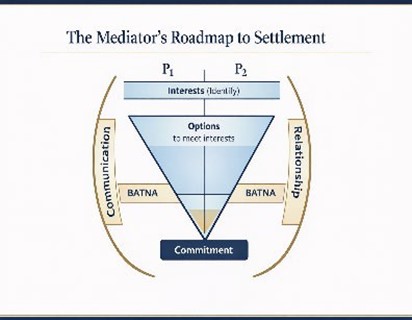
Once parties begin to explore interests and identify opportunities for value creation, the mediator can guide the negotiation through a structured process that moves the parties toward agreement. One useful way to conceptualize this process is through the mediator’s roadmap to settlement.
Once parties begin to explore interests and identify opportunities for value creation, the mediator can guide the negotiation through a structured process that moves the parties toward agreement. One useful way to conceptualize this process is through what may be described as the mediator’s roadmap to settlement, illustrated in the following diagram.
Although every mediation unfolds differently, experienced mediators often guide negotiations through a recognizable sequence:
Interests → Options → BATNA → Commitment
At the top of the framework, the mediator helps the parties identify the interests underlying their positions. After gaining an understanding of those interests, the mediator can help the parties develop possible solutions to address them. Only after options have been explored do the parties meaningfully evaluate their alternatives, including continued litigation.
The diagram represents this progression as an inverted funnel. The negotiation begins broadly with exploration of interests and options and gradually narrows as the parties evaluate alternatives and move toward commitment.
Importantly, two additional forces shape the entire process: communication and relationship. As illustrated in the diagram, these elements surround the negotiation framework because they influence every stage in the mediation. Without effective communication and a workable negotiation relationship, interests remain hidden, options fail to emerge, and the parties cannot realistically evaluate their alternatives.
The following subsections explain the key components of the mediator’s roadmap. Each component of this framework plays a distinct role in helping the parties evaluate settlement realistically and move toward agreement.
1. BATNA or BATMA: Alternative to a Negotiated or Mediated Agreement
Negotiators rarely evaluate settlement proposals in isolation. Instead, they compare those proposals to their perceived alternatives. Fisher and Ury describe this concept as the Best Alternative to a Negotiated/Mediated Agreement, or BATNA/BATMA.28
In litigation disputes, the BATNA usually involves continuing the case toward trial. When parties believe their litigation prospects are strong, settlement may appear unnecessary. Conversely, when litigation risk appears substantial, settlement becomes more attractive.
Importantly, the parties’ perception of their BATNA often differs from the objective reality of litigation risk. Cognitive biases, adversarial advocacy, and emotional investment in the dispute may cause parties to overestimate the strength of their position.29
Mediators frequently assist parties in reassessing their BATNA through reality testing. Rather than predicting trial outcomes, mediators ask questions that encourage participants to consider how judges, juries, or appellate courts might evaluate disputed facts and legal arguments. Questions about litigation costs, evidentiary uncertainties, and the unpredictability of jury decision-making can help parties evaluate their alternatives more realistically.
As parties begin to reassess their alternatives, settlement proposals that once seemed unacceptable may appear more reasonable.
2. ZOPA: The Hidden Settlement Zone
Closely related to BATNA is the concept of the Zone of Possible Agreement, or ZOPA. The ZOPA represents the range within which settlement is possible because a negotiated outcome would be preferable to each party’s alternative.30
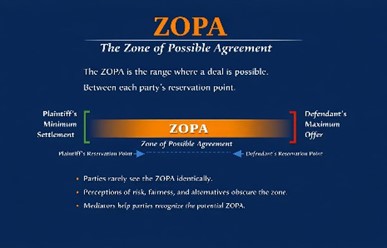
In theory, when both parties accurately understand their BATNAs, the ZOPA becomes visible. In practice, however, mediators frequently observe impasse even when such a settlement zone objectively exists. The difficulty is that parties rarely perceive the ZOPA in the same way.
Litigation optimism, emotional reactions, and adversarial framing may obscure the existence of a settlement zone. Each side may believe that its alternative to settlement is significantly better than it actually is. As a result, the parties may assume that no overlap exists between their expectations.
One of the mediator’s central tasks is therefore helping the parties recognize the settlement zone that may already exist. As perceptions of litigation risk change and the parties reassess their alternatives, the previously hidden ZOPA often becomes visible. When that occurs, negotiations that once appeared locked in impasse may begin to move toward agreement.
In practice, experienced mediators may conclude that the parties’ settlement positions appear to fall within a Zone of Possible Agreement even though the parties themselves have not yet recognized that overlap. In such circumstances, a mediator may suggest the possibility of a mediator’s proposal as a procedural mechanism to test whether agreement can be reached within that zone. If both parties agree to the process, the mediator may formulate a specific settlement proposal or structure and ask each side to respond confidentially with acceptance or rejection. Because the proposal is presented as the mediator’s recommendation rather than as an offer from either party, it can reduce reactive devaluation and allow participants to evaluate the proposal more objectively. When the mediator correctly perceives that the parties are operating within a ZOPA, the mediator’s proposal can provide a face-saving mechanism that allows both sides to accept a settlement that might otherwise be difficult for either party to propose directly.
3. Communication and Relationship
Communication plays a central role in mediation. Information must move between the parties before perceptions can shift. Techniques such as active listening, reframing, and careful questioning allow mediators to clarify misunderstandings and reduce the emotional intensity of the negotiation.
Equally important is the negotiation relationship environment. In mediation, relationship does not mean friendship or agreement. Rather, it refers to whether the parties feel able to listen, exchange information, and engage in constructive dialogue. When trust is low, parties tend to defend positions rather than explore interests.
The work of Stone, Patton, and Heen helps explain why these dynamics are so significant. Difficult conversations often involve not only disagreements about facts, but also underlying concerns related to feelings and identity.31 When parties feel misunderstood or disrespected, negotiations frequently become more defensive and less productive.
Mediators can stabilize the negotiation environment by acknowledging emotions without validating accusations, reframing hostile statements into neutral language, and demonstrating that each party has been heard. These techniques help restore communication and create the conditions necessary for interest-based negotiation to occur.
Seen in this way, communication and relationship dynamics form the outer structure of the mediator’s roadmap. They surround and support the entire negotiation process. When communication is effective and the negotiation environment is stable, the mediator can guide the parties from interests to options, to a realistic evaluation of alternatives, and ultimately to commitment.
G. Shifting Perceptions: Risk, Fairness, and Possibility
The Mediator’s Roadmap provides the structural framework for negotiation. Yet movement toward settlement ultimately depends on how the parties perceive the dispute.
The mediator’s most significant influence in negotiation does not lie in dictating outcomes or persuading parties to accept particular settlement terms. Rather, it lies in helping the parties reassess how they perceive the dispute itself. In many mediations, settlement becomes possible only after one or more of three key perceptions begin to change: perceptions of risk, fairness, and possibility.
Importantly, these shifts do not occur because the mediator imposes a conclusion on the parties. Instead, they occur because the mediator creates the conditions under which the parties and their counsel begin to reconsider the dispute for themselves. Once interests have been identified and options developed through effective communication, parties often begin to reevaluate their assumptions about the case, their alternatives, and the potential outcomes of continued litigation.32
1. Risk
The first perception concerns risk, particularly the uncertainty inherent in litigation. Parties frequently enter mediation with strong confidence in their likelihood of success at trial. Plaintiffs may believe that the evidence clearly supports their claims, while defendants may be equally convinced that liability can be avoided. Negotiation scholars have long observed that such confidence is often reinforced by cognitive biases such as selective perception and confirmation bias.33
Mediators typically address risk perception through a process commonly described as reality testing. Rather than telling a party that his or her case is weak, the mediator asks questions that encourage participants to reflect on how neutral decision-makers might evaluate disputed evidence or legal arguments. Questions about how jurors might interpret conflicting testimony, how a judge might rule on evidentiary issues, or how an appellate court might review a disputed legal question can prompt parties to consider uncertainty more seriously.34
When this occurs, the shift in perception does not come from the mediator’s authority but from the party’s own reassessment of the situation. The client, often in consultation with counsel, begins to recognize that the outcome of litigation is less predictable than previously assumed. As that perception of risk evolves, settlement proposals that once seemed unacceptable may begin to appear more reasonable.
2. Fairness
The second perception concerns fairness. Even when parties acknowledge litigation risk, settlement proposals may still be rejected if they appear inconsistent with a party’s sense of justice. Negotiation research consistently demonstrates that individuals evaluate outcomes not solely through economic calculations but also through fairness norms and legitimacy concerns.35
Mediators often address fairness concerns by encouraging the parties to evaluate proposals using objective criteria. Roger Fisher and William Ury famously emphasized that negotiators can move beyond positional bargaining by grounding discussions in standards independent of either party’s will.36 In litigation mediation, these standards may include legal precedent, comparable jury verdicts, industry practices, or other benchmarks that provide a frame of reference for evaluating proposed outcomes.
When parties begin to view a proposal as falling within a reasonable range—one that a neutral decision-maker might plausibly reach—their perception of fairness often changes. Importantly, this shift typically occurs within the parties themselves. The mediator may introduce information or questions that encourage reflection, but it is the client, often guided by counsel, who ultimately reassesses whether a proposed outcome is acceptable.
3. Possibility
The third perception concerns possibility. Some negotiations stall not because the parties disagree about the merits of the case, but because they cannot imagine a mutually acceptable resolution. When disputes are framed as purely zero-sum contests, compromise may appear impossible.
Mediators address this perception by expanding the range of options under consideration. Through careful questioning and exploration of interests, mediators may uncover differences in priorities, timing preferences, risk tolerance, or nonmonetary concerns that create opportunities for mutually beneficial solutions. The well-known “orange example” from negotiation literature illustrates this dynamic: two parties arguing over a single resource may discover that their underlying interests allow both to achieve their objectives once those interests are revealed.37
As new options emerge, parties often begin to see that the dispute can be resolved in more than one way. This expansion of perceived possibility can transform the negotiation environment. Instead of viewing settlement as a loss, parties begin to see it as a viable alternative to continued conflict.
4. The Role of the Parties in the Shift
These shifts in perception ultimately occur within the parties themselves. The mediator’s role is to facilitate communication, identify interests, and help the parties explore options that may satisfy those interests. Once those conditions are established, clients and their attorneys begin to evaluate the dispute through a different lens.
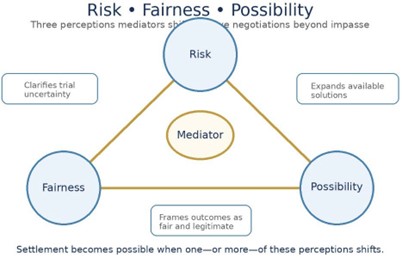
In many mediations, the critical moment occurs when a client turns to counsel and asks a question that reflects a new understanding of the situation: What do you think a jury would actually do? or Is this outcome within the range we might expect if we continued litigating? At that point, the negotiation is no longer driven solely by positions but by a more realistic assessment of risk, fairness, and available possibilities.
These perceptions also interact with one another. A shift in risk perception may make a proposal appear more reasonable. When a proposal appears fair relative to objective criteria, resistance to compromise may diminish. And when the mediator expands the range of possible solutions, negotiations that once appeared locked in impasse may begin to move toward resolution.
Seen in this way, mediation does not produce agreement through coercion or persuasion. Rather, it facilitates a process through which parties gradually reconsider how they understand the dispute and, in doing so, discover a path toward settlement.
Mediators cannot force agreement — but they can create the conditions in which the parties see the dispute differently
H. Managing Gorilla Attorneys
Mediators occasionally encounter situations in which counsel tightly controls communication between the mediator and the client. In these circumstances, the negotiation dynamic can resemble what negotiation scholar Lawrence Susskind describes as negotiating with a “900-pound gorilla”—a participant who dominates the negotiation environment and attempts to dictate the terms of interaction.38
In mediation, the “gorilla” is rarely an opposing party with overwhelming economic power. Instead, it may appear in the form of a lawyer who insists on controlling the flow of information, limits communication between the mediator and the client, or attempts to direct the negotiation process in ways that restrict meaningful dialogue. Although attorneys play an essential role in advising clients about legal rights, strategy, and risk, excessive control over communication can prevent the mediator from helping the parties reassess their perceptions of the dispute.
Experienced mediators often address this dynamic before the mediation begins. Pre-mediation conversations with counsel allow the mediator to establish rapport and to signal respect for the attorney’s role as the client’s legal advisor. By acknowledging that counsel remains responsible for advising the client regarding legal strengths, weaknesses, and litigation strategy, mediators can reduce concerns that direct communication with the client might undermine the attorney–client relationship.
At the same time, mediators must maintain control of the process. While lawyers advocate for their clients’ legal positions, the mediator manages the structure of the negotiation. This distinction is critical. Mediation functions best when the mediator is able to communicate with both lawyers and clients, ask questions directly, and facilitate conversations that allow the parties to explore interests, options, and alternatives. Such dialogue is often essential for helping the parties reassess litigation risks, evaluate the fairness of potential outcomes, and recognize new possibilities for resolution.
When counsel attempts to restrict communication—for example, by preventing the mediator from speaking directly with the client or by answering questions on the client’s behalf—mediators can address the issue in ways that preserve professional relationships. One approach is to explain that direct communication with the client helps the mediator understand the client’s interests, concerns, and decision-making priorities. By framing the conversation as an effort to better understand the client’s perspective rather than to challenge counsel’s authority, the mediator can often obtain cooperation without confrontation.
In situations where disagreements arise regarding case evaluation or litigation strategy, experienced mediators typically address those issues privately with counsel rather than in the client’s presence. Private conversations allow the mediator to raise questions about litigation risk or legal arguments without inadvertently undermining the attorney’s credibility before the client. These discussions can be particularly important when certain assumptions about the case may be affecting the client’s evaluation of settlement options.
Even when counsel remains highly protective of the client’s role in the process, mediators can still influence the negotiation by focusing on communication and perception. By asking open-ended questions, encouraging reflection on litigation risk, and exploring the client’s underlying concerns, mediators help create the conditions in which clients and their attorneys reassess the dispute together. Negotiation scholars have long observed that many disputes appear purely distributive when, in fact, opportunities for value creation exist once underlying interests are explored.39
In many mediations, the most meaningful shifts in perception occur during private conversations between lawyer and client after the mediator has introduced new information or perspectives. At that point, the client and counsel begin to evaluate the dispute together—considering the uncertainty of litigation, the fairness of potential outcomes, and the range of possible solutions.
Negotiation scholarship also suggests that even powerful negotiating partners are often open to thoughtful engagement around interests, principles, and long-term outcomes. Susskind observes that when dealing with dominant negotiating actors, negotiators can sometimes shift the balance of the discussion by identifying shared interests, appealing to principles of fairness, and proposing solutions that create value for both sides.40 Similar strategies in mediation can transform lawyer-dominated negotiations into more productive dialogue.
Ultimately, the mediator’s goal is not to challenge the attorney’s authority but to ensure that the negotiation environment allows the client to participate meaningfully in evaluating the dispute. When that environment exists, clients and counsel are better able to reconsider their assumptions about risk, fairness, and possible outcomes. In this way, even negotiations dominated by strong personalities can evolve toward resolution once the mediator creates a process in which both lawyer and client are able to reassess the dispute together.
I. Qualities of an Effective Mediator
The strategies described throughout this article—from identifying perception traps to exploring interests, creating value, structuring negotiation through the mediator’s roadmap, and helping parties reassess risk, fairness, and possibility—require more than familiarity with negotiation theory. They depend on the mediator’s ability to manage complex human dynamics, maintain credibility with both counsel and clients, and guide difficult conversations without imposing outcomes.
Effective mediators, therefore, rely on a set of professional qualities that allow them to stabilize negotiation environments, encourage meaningful dialogue, and help parties reconsider how they view the dispute. These qualities often determine whether the mediator is able to transform adversarial bargaining into a problem-solving process capable of producing agreement.
Although mediation techniques vary, exceptional mediators tend to exhibit several consistent professional habits.
1. Diagnose Before Solving
Effective mediators resist the urge to push parties toward solutions before understanding the dynamics of the dispute. By carefully listening to the parties’ concerns, identifying barriers to negotiation, and recognizing the interests underlying positions, mediators develop a clearer understanding of the obstacles preventing agreement.
2. Focus On Interests Rather Than Positions
Positions often conceal the motivations driving negotiation behavior. Skilled mediators probe beneath surface demands to identify the interests that explain why those demands matter, creating opportunities for solutions that satisfy the parties’ underlying concerns.
3. Lower The Emotional Temperature Of The Dispute
Many conflicts persist because emotions escalate the dispute beyond the legal issues at stake. Effective mediators acknowledge emotions, encourage respectful communication, and help parties move from confrontation to constructive dialogue.
4. Ask Questions That Prompt Reflection
Rather than telling parties what they should do, experienced mediators ask questions that encourage participants to reconsider their assumptions. Thoughtful questions about litigation risk, legal uncertainty, and practical consequences often prompt parties to reevaluate their positions.
5. Expand The Negotiation Space
Mediators help parties move beyond narrow bargaining over numbers by identifying additional options and exploring differences in priorities, timing, risk tolerance, or non-monetary concerns. By broadening the scope of discussion, mediators increase the likelihood of mutually beneficial solutions.
6. Reframe Narratives In Constructive Ways
Parties frequently describe disputes in accusatory or adversarial terms that reinforce conflict. Skilled mediators reframe those narratives into language that focuses on interests, concerns, and future solutions rather than past blame.
7. Help Parties Preserve Dignity and Save Face
Settlement often requires parties to compromise positions they have defended vigorously. Effective mediators recognize the importance of dignity and legitimacy, helping parties reach agreements in ways that allow them to maintain credibility with clients, colleagues, or stakeholders.
The seven habits enable mediators to guide negotiations through difficult moments and move parties beyond impasse. More importantly, they help create the conditions in which parties are able to reassess the dispute through new perspectives. When mediators stabilize the negotiation environment, surface underlying interests, and encourage thoughtful reflection, parties often begin to reconsider the risks of continued conflict, the fairness of proposed outcomes, and the possibilities available through settlement. In this way, the mediator’s work ultimately returns to the central insight of mediation practice: agreement becomes possible when the parties begin to see the dispute differently.
J. Conclusion
Ultimately, mediation succeeds not because the mediator persuades the parties to settle, but because the mediator helps them see the dispute in a way that makes settlement possible.
Mediation is often described as a structured negotiation process designed to help parties reach voluntary agreements. While accurate, that description does not fully capture the mediator’s influence.
Exceptional mediators do not move negotiations merely by exchanging numbers. They move negotiations by helping parties see the dispute differently. By uncovering interest, expanding options, and shifting perceptions of risk, fairness, and possibility, mediators transform negotiations that once appeared immovable.
Impasse, therefore, rarely means that settlement is impossible. More often, it means the parties have not yet seen the dispute clearly enough.
When perceptions begin to shift, settlement often follows. For mediators, the lesson is clear: the path beyond impasse rarely lies in pressing harder on numbers, but in helping the parties see the dispute through a different lens.
---------------------------------------
1 See Russell Korobkin & Chris Guthrie, Psychological Barriers To Litigation Settlement, 93 Mich. L. Rev. 107 (1994).
2 Roger Fisher & William Ury, GETTING TO YES: NEGOTIATING AGREEMENT WITHOUT GIVING IN, 40-43 (1981).
3 William Ury, GETTING PAST NO: NEGOTIATING YOUR WAY FROM CONFRONTATION TO COOPERATION, 36-37 (1991).
4 See Lee Ross & Andrew Ward, Naïve Realism in Everyday Life: Implications for Social Conflict and Misunderstanding, in VALUES AND KNOWLEDGE 103, 110–14 (Edward S. Reed et al. eds., 2000) (describing partisan perception and the tendency of individuals to interpret information in ways that confirm their existing beliefs); Russell et al., supra note 2, at 129–34 (discussing selective perception, confirmation bias, and other cognitive biases affecting settlement decisions); Robert H. Mnookin, Scott R. Peppet & Andrew S. Tulumello, BEYOND WINNING: NEGOTIATING TO CREATE VALUE IN DEALS AND DISPUTES 165–72 (2000)
5 Ross & Ward, supra note 5, at 103.
6 Russell, et al., supra note 2, at 129–34.
7 Mnookin, et al., supra note 5, at 166–67.
8 Daniel Kahneman & Amos Tversky, Prospect Theory: An Analysis of Decision Under Risk, 47 Econometrica 263 (1979).
9 Daniel Kahneman, Jack L. Knetsch & Richard H. Thaler, Experimental Tests of the Endowment Effect, 98 J. Pol. Econ. 1325 (1990).
10 Lee Ross & Constance Stillinger, Barriers to Conflict Resolution, 7 Negotiation J. 389 (1991).
11 See e.g., Fisher et al., supra note 3, at 21-22.
12 Douglas Stone, Bruce Patton & Sheila Heen, DIFFICULT CONVERSATIONS: HOW TO DISCUSS WHAT MATTERS MOST 38–45 (1999).
13 Mnookin, et al., supra note 5, at 166–168.
14 Fisher et al., supra note 3, at 22–27.
15 Ury, supra note 4, at 36-39, 76-80.
16 See id.; see also Stone, et al., supra note 13, at 38-45.
17 Fisher et al., supra note 3, at 40–55.
18 Mnookin, et al., supra note 5, at 11–14, 165–174.
19 Fisher et al., supra note 3, at 40–55.
20 Mnookin, et al., supra note 5, at 11–20.
21 Fisher et al., supra note 3, at 56–80.
22 See id. at 56–59.
23 Id.
24 Mnookin, et al., supra note 5, at 11–20.
25 Id. at 12–14.
26 Fisher et al., supra note 3, at 58–59.
27 David A. Lax & James K. Sebenius, 3-D NEGOTIATION: POWERFUL TOOLS TO CHANGE THE GAME IN YOUR MOST IMPORTANT DEALS 69–88 (2006).
28 Fisher et al., supra note 3, at 100–106.
29 Mnookin, et al., supra note 5, at 165–67.
30 Lax, et al., supra note 28, at 69–88.
31 Stone, et al., supra note 13, at 9.
32 See Leonard L. Riskin, Understanding Mediators’ Orientations, Strategies, and Techniques, 1 Harv. Negot. L. Rev. 7, 24–34 (1996).
33 Mnookin, et al., supra note 5, at 165–72.
34 Id.; see also Lawrence Susskind, Negotiating with a 900-Pound Gorilla 3-5 (Harvard Business School, 2006).
35 Fisher et al., supra note 3, at 81–94.
36 Id.
37 Id. at 56–62.
38 Susskind, supra note 35, at 3.
39 Mnookin, et al., supra note 5, at 11–20, 44–68.
40 Susskind, supra note 35, at 3-5.
N.B. Regarding the figures used in this article, the conceptual framework is based on Harvard Negotiation Project principles with mediation-specific adaptations from principles in Roger Fisher, William Ury & Bruce Patton, Getting to Yes: Negotiating Agreement Without Giving In (3d ed.).